Machining Custom Metal Knobs: Knurling, Finishes and Fits
A good metal knob depends as much on its bore fit and runout as on its finish. This guide covers knurling patterns, materials, finishes and the main ways knobs attach to shafts in audio, appliance and automotive controls.
By the Axisform engineering teamPublished Updated 7 min read
A custom machined metal knob is usually turned from aluminum, brass or stainless steel bar, knurled or textured for grip, finished by anodizing, plating or PVD, and attached with a set screw, a D-shaped bore or a splined (knurled) bore that matches the shaft. The right combination depends on the shaft you are fitting, the feel you want and the environment: anodized 6061 aluminum with a set screw suits most audio and instrument knobs, while appliance and automotive interior knobs more often need a press-fit D or spline bore and a durable finish. Getting the fit and runout right matters as much as the look, because a knob that wobbles feels cheap regardless of its finish.
What are machined knobs used for?
Machined metal knobs appear wherever a control is touched often and should feel solid:
Audio: amplifiers, preamps, mixing consoles, guitar pedals, DJ equipment and studio gear.
Appliances: ovens, cooktops, coffee machines and premium kitchen equipment.
Automotive interiors: volume, climate and drive-mode controls, often with tight cosmetic standards.
Instruments and industrial controls: test equipment, lighting consoles and machine tools.
Compared to molded plastic knobs, machined metal knobs offer weight, rigidity, precise concentricity and finishes that plastic cannot reproduce. For higher volumes, zinc die casting with machined finishing is an alternative.
How are metal knobs machined?
Most knobs are rotationally symmetric, so they are made on a CNC lathe or turn-mill center:
Turning the outer profile, face, skirt and bore from bar stock in one setup, which keeps the bore and outer diameter concentric.
Knurling the grip surface on the lathe.
Milling secondary features with live tooling: indicator lines, flats, cross holes for set screws, finger dimples.
Broaching or wire EDM for D-shaped or splined bores.
Finishing: bead blasting, brushing, anodizing, plating or PVD, plus laser marking.
Small knobs can be produced efficiently on Swiss-type style lathes. Knobs with off-axis features, such as a pointer skirt or an asymmetrical lever, may need 4- or 5-axis milling — see 3-axis vs 4-axis vs 5-axis CNC machining.
What knurling patterns are available?
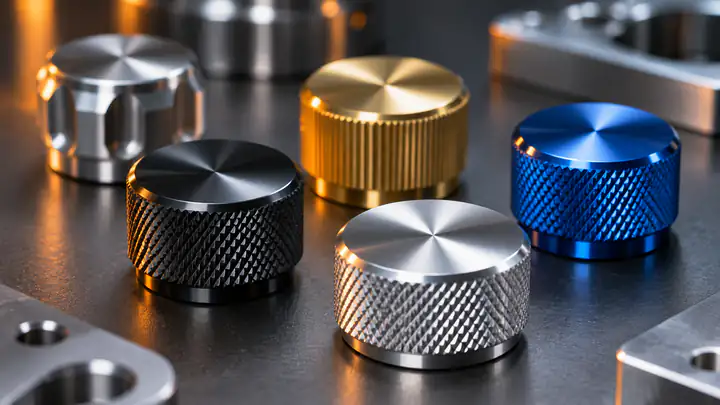
Knurling creates a textured grip on the knob surface. Patterns are standardized in DIN 82:
DIN 82 type
Pattern
Typical use
RAA
Straight (axial) knurl, lines parallel to the axis
Audio knobs, fine "coin edge" look, rotation grip
RBR / RBL
Diagonal knurl, right-hand or left-hand
Decorative, less common alone
RGE
Diamond knurl, raised points (male)
Strong grip, industrial and tool knobs
RGV
Diamond knurl, recessed points (female)
Softer feel, cleaner look
RKE / RKV
Cross knurl (perpendicular lines)
Decorative and grip surfaces
What knurl pitch should you choose?
Common pitches range from about 0.5 mm to 1.6 mm. Fine pitches (around 0.5–0.8 mm) give a refined look and suit small audio knobs. Coarser pitches give a stronger grip for gloved hands or high-torque controls. Pitch should suit the diameter so the pattern closes evenly around the circumference.
Form knurling vs cut knurling
Form (roll) knurling presses the pattern into the surface. It is fast but slightly increases the diameter and needs a ductile material.
Cut knurling removes material with sharp knurl wheels, producing crisp patterns with less force, which is better for thin-walled knobs and harder materials.
Many premium audio knobs use fine milled or diamond-turned patterns instead of traditional knurls: radial grooves, concentric face rings or faceted edges.
Which materials work best for machined knobs?
Material
Characteristics
Typical finish
Typical use
6061 / 6063 aluminum
Light, easy to machine, excellent anodizing
Bead blast + anodize, brushed + anodize
Audio, consumer electronics
7075 aluminum
Harder, sharper edges
Anodize
Premium knobs needing wear resistance
Brass (C36000)
Heavy, smooth feel, very machinable
Nickel, chrome or PVD plating, or polished and lacquered
Audio, luxury appliances
Stainless steel 303 / 304
Durable, corrosion resistant, heavy
Brushed, bead blasted, polished, PVD
Appliances, marine, industrial
Titanium (Gr5)
Light, strong, distinctive color
Bead blast, anodize (interference colors), PVD
Specialty and premium products
Zinc alloy (die cast)
Economical at volume, heavy
Plating, painting
High-volume appliance and automotive
Weight matters for feel. A heavier knob adds rotational inertia, which makes a volume knob spin more smoothly and makes detents feel more deliberate. Brass and stainless steel feel heavier than aluminum; aluminum knobs can be given brass or steel inserts for mass without the cost of a solid brass knob.
Which finishes suit knobs?
Bead blast + Type II anodize: the standard modern matte look, uniform and scratch-tolerant. See our anodizing guide.
Brushed + anodize: linear or circular brushed grain under a clear or tinted coating.
Diamond-cut chamfer: a bright, machined edge cut after anodizing for contrast.
Polishing: mirror finish, best on brass and stainless steel.
Electroplating: nickel and chrome on brass or zinc for a classic appearance.
PVD: thin, hard decorative coatings in gold, black, gunmetal and bronze tones on stainless steel and brass, with good wear resistance.
Laser engraving: indicator lines, scales and logos; on anodized aluminum the mark is crisp and permanent.
Automotive interior knobs are touched constantly and exposed to sweat, sunscreen and UV. Ask about abrasion and chemical resistance testing to your specification rather than assuming a decorative finish is enough.
How should a knob attach to its shaft?
The attachment method is set by the shaft on the potentiometer, encoder or valve you are fitting. Measure the shaft or check its datasheet before designing the bore.
Set screw fit
A threaded radial hole holds a grub screw (often M3 or M4) that tightens against the shaft.
Works on plain round shafts, flatted shafts and many knurled shafts.
Tolerant of shaft variation; easy to adjust and remove.
Use two set screws at 90° for a more secure, centered grip on larger knobs.
Use nylon- or brass-tipped set screws to avoid marking the shaft.
The set screw hole is visible unless it is hidden under a cap, skirt or within a recess.
D-shaft fit
The bore has a flat matching a D-shaped shaft, so the knob cannot rotate on the shaft and aligns automatically with the indicator line.
Common on potentiometers, encoders and appliance controls; 6 mm D-shafts are widely used.
Can be a slip fit with a set screw or a press fit without hardware.
The D-bore is typically made by broaching or wire EDM; the flat's position relative to the indicator line must be toleranced.
Spline or knurled-shaft fit
Many potentiometer and encoder shafts are knurled with fine axial serrations, commonly 18 or 24 teeth on 6 mm and 1/4 in shafts. A matching splined bore or a press-fit plastic or brass insert grips the shaft.
Clean exterior with no visible screw.
Allows indexing in small steps around the shaft.
Requires accurate bore sizing; too tight cracks the bore or damages the shaft, too loose lets the knob slip.
A split shaft with a press-on knob uses the shaft's own spring force.
Collet fit
A collet knob uses an internal collet that is tightened through the knob face, then covered with a cap. It centers the knob precisely and fits a range of plain shafts, which is popular in professional audio equipment.
Fit comparison
Fit type
Exterior
Alignment
Typical use
Set screw
Visible screw (unless hidden)
Adjustable
Audio, instruments, prototypes
D-shaft
Clean or with set screw
Fixed, self-aligning
Appliances, encoders
Spline / knurled
Clean
Indexable
Potentiometers, consumer devices
Collet
Clean, with cap
Precise centering
Professional audio
What tolerances matter on a knob?
Bore diameter to the shaft: a slip fit for set screw knobs, an interference fit for press-on knobs.
Runout between the bore and the outer diameter — the main cause of visible wobble.
Face perpendicularity to the bore.
Indicator line angle relative to the D-flat or spline.
Finish thickness in the bore — mask the bore or machine it to the post-finish size.
Our tolerance guide covers how to specify these features without over-tolerancing.
How Axisform makes knobs
Axisform produces custom knobs with CNC turning and turn-mill, broaching, wire EDM, knurling and laser marking, finished with anodizing, plating, polishing or PVD. Quantities start at one piece for prototypes. See products and projects, or send your drawing and shaft details via contact.
Frequently asked questions
What is the best material for a metal knob?
Anodized 6061 aluminum is the most common choice because it is light, easy to machine and takes uniform color. Brass and stainless steel are chosen for weight and a premium feel, and zinc die casting suits high volumes.
What is the difference between straight and diamond knurling?
Straight knurling has lines parallel to the knob axis and gives a refined, coin-edge look with good rotational grip. Diamond knurling has crossing diagonal lines that form raised or recessed points and gives a stronger grip in every direction.
How do I choose between a set screw and a D-shaft knob?
Use a set screw when the shaft is plain round or when you want adjustability. Use a D-shaft bore when the shaft has a flat and you want the knob to align automatically with its indicator and resist slipping without visible hardware.
Why does my knob wobble on the shaft?
Wobble is usually caused by runout between the bore and the outer diameter, a loose bore fit or a single set screw pushing the knob off-center. Machining the bore and outside diameter in one setup and using a correct fit or two set screws fixes most cases.
Written by the Axisform engineering team
Manufacturing and quality engineers at our Dongguan machining factory. Questions about this guide? Email us.
Need parts made to these principles?
Send your drawing and an engineer will reply with DFM notes and a quote within 24 hours.
Sheet metal is usually cheaper for uniform-wall enclosures and brackets, while CNC machining wins on varying thickness and tight tolerances. This guide compares both and explains bend radius and K-factor basics.
Most quality problems with imported machined parts come from requirements that were never written down. This guide walks through the RFQ package, first article approval, inspection documents, Incoterms and shipping.
Most of the cost of a machined part comes from machine time, setups and inspection rather than material. These 12 design rules target each of them without changing how the part works.