CNC Turned Brass and Bronze Precision Components
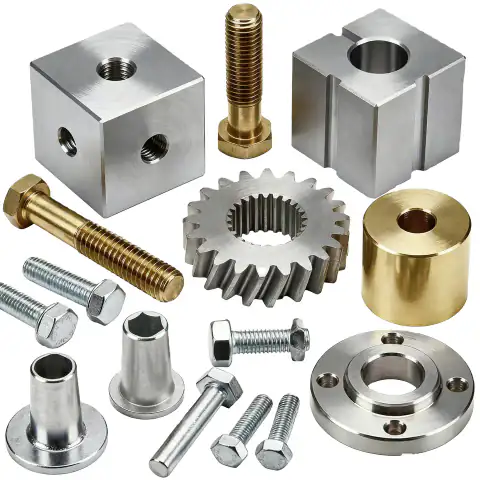
These are precision components turned and milled from brass and bronze, including bushings, plain bearings, nozzles, electrical contacts and threaded connectors. Brass gives easy machining and clean threads; bronze adds wear resistance and load capacity. The service suits equipment, valve and electrical designers who need copper-alloy parts held to precise diameters and concentricity.
- Material
- Brass
- Tolerance
- to ±0.005 mm
- MOQ
- 1 piece
- Prototype lead time
- 3–7 days
- Brass for fittings, bronze for bearings and wear
- Bores and outer diameters finished in one setup
- Oil grooves cut in bronze bushings
- Material certificates on request
Item ref. 1601927238901 ·
| Process | CNC turning, Swiss-type style turning, boring, reaming, milling |
|---|---|
| Materials | Brass C36000/H59/H62, tin bronze, aluminum bronze |
| Surface Finish | As machined, nickel or chrome plating, polishing |
| Tolerance | ±0.05 mm standard; down to ±0.005 mm on critical features |
| MOQ | 1 piece; prototypes through mid-volume runs |
| Drawing Formats | STEP, IGES, X_T, STL, DWG, DXF, PDF |
| Lead Time | Prototypes typically 3–7 working days; production usually 10–20 |
| Inspection | FAI, in-process checks, 100% critical dimensions; CMM |
Manufacturing
How we make this part
Process, material options and inspection for cnc turned brass and bronze precision components.
Both alloys are turned on CNC lathes, with bores finished by boring or reaming for accurate bearing fits. Oil grooves in bronze bushings are cut with form tools or milled in spiral patterns. Long parts are supported with tailstocks or turned on Swiss-type style lathes. Concentricity between outer diameter and bore is held by finishing both in one setup.
C36000 brass is the most machinable copper alloy and the default for fittings and contacts. Bronze grades such as tin bronze and aluminum bronze are harder and handle sliding loads, which is why they are used for bushings and wear plates. Bronze machines more slowly and costs more. Brass can be nickel or chrome plated; bronze is usually left bare for bearings.
Bores, outer diameters and concentricity are checked with bore gauges, micrometers and CMM. Critical dimensions are verified on every lot, and material certificates are available on request. Typical uses include sleeve bearings, thrust washers, valve seats, spray nozzles, terminal posts, musical instrument parts and threaded connectors for pumps, valves, audio and electrical equipment.
FAQ
Frequently asked questions
Should I use brass or bronze for a bushing?
Bronze for most bushings. It has better wear resistance and load capacity, and it tolerates sliding against steel shafts with lubrication. Brass is acceptable for lightly loaded, low-speed pivots and costs less to machine. For dry-running bushings, oil-impregnated sintered bronze or a polymer like POM may be better.
What concentricity can you hold on turned bronze bushings?
When the outer diameter and bore are finished in the same setup, concentricity within about 0.01–0.02 mm is typical, and tighter is possible on critical parts. Please put the concentricity or runout tolerance on the drawing so we machine and inspect to it.
How do I get a quote for cnc turned brass and bronze precision components?
Send a 3D model (STEP or IGES) and a 2D drawing with tolerances, material, finish and quantity through the quote form or by email. An engineer replies within 24 hours on business days with price, lead time and any DFM suggestions.
Request a quote
Quote this part
Attach drawings or send several parts at once from the full quote form.
- Email[email protected]
- WhatsApp+86 176 2154 1688
- Phone+86 176 2154 1688
- HoursMon–Sat, 08:30–18:00 China Standard Time (UTC+8)