ISO 9001 precision machining factory in Dongguan, China — prototypes to production, shipped worldwide[email protected]+86 176 2154 1688

CNC Turned LED Heat Sink Housings in 6063 Aluminum

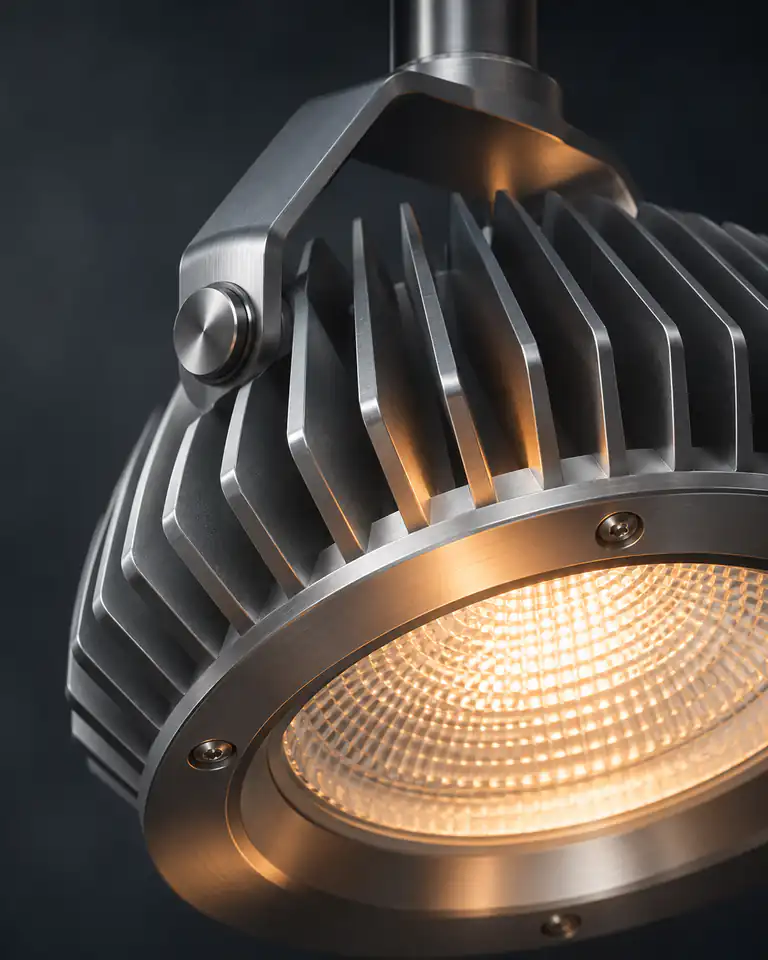
A lighting manufacturer needed round heat sink housings for a high-output LED fixture, turned and milled from 6063 aluminum. The main requirements were a flat, smooth LED mounting face for good thermal contact, deep turned fins, and sealing threads for the lens ring and cable gland.

  • Lighting
Part
Round LED heat sink housing with integral fins
Material
6063-T6 aluminum bar
Process
CNC turning, turn-mill drilling and tapping
Critical tolerance
LED mounting face flatness 0.05 mm; thread fit 6H
Finish
Type II black anodize, LED pad masked
Batch type
Prototype → mid-volume production
Inspection
Flatness and roughness check, thread gauges, visual

The challenge

In an LED fixture, the heat sink sets how hot the LEDs run, and LED life depends strongly on junction temperature. Heat leaves the LED board through a thin thermal interface material into the housing, so the quality of that contact face matters as much as the fin area.

The drawing required:

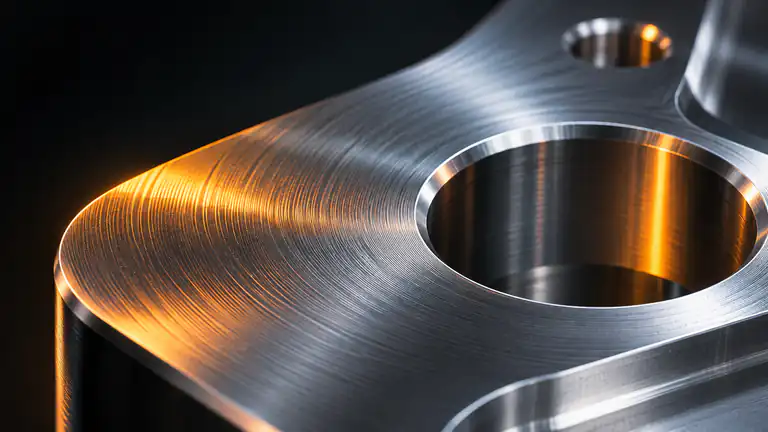
  • LED mounting face flatness of 0.05 mm and roughness of Ra 0.8 µm or better, so the thermal pad or paste can be kept thin and even
  • Radial fins turned to a depth of several times their thickness, with consistent wall thickness for even heat spreading and appearance
  • Fine-pitch thread for the lens retaining ring, with a sealing shoulder for an O-ring
  • Cable gland thread on the back face, plus tapped holes for the LED board

The customer chose 6063 for its higher thermal conductivity (around 200 W/m·K, compared with about 167 W/m·K for 6061-T6). 6063 is softer and stickier to machine, which makes deep, thin fins harder to cut cleanly without burrs or tearing.

Our approach

We kept the job on turning and turn-mill equipment, which suits round heat sinks and keeps faces and threads concentric.

  1. DFM review. We checked fin pitch and depth against grooving-tool reach and recommended a small draft on the fin flanks. This lets a stronger grooving insert be used and reduces chatter in 6063.
  2. Op 1, back side. From 6063-T6 bar, we turned the back face, cable gland boss and thread, and the outer diameter used as the datum for the second operation.
  3. Op 2, front side. Gripped on the finished diameter with soft jaws, we turned the front face, lens ring thread and O-ring shoulder.
  4. Fin grooving. Fins were cut with a dedicated grooving insert in several pecking steps, with high-pressure coolant to clear chips out of the grooves. Polished inserts with sharp edges were used because 6063 tends to build up on the tool.
  5. LED mounting face. The face was finished with a light pass using a wiper insert to reach the roughness target in one cut.
  6. Turn-mill drilling and tapping. LED board holes and side features were drilled and tapped on the live-tool lathe in the same clamping as the face, so hole positions stay true to the face.
  7. Deburring and cleaning. Fin edges were deburred with brushes and the parts were cleaned of coolant residue.
  8. Anodizing. The LED mounting pad was masked and the housing was Type II black anodized. A black anodized surface radiates heat better than bare aluminum, while a bare pad avoids adding an insulating oxide layer under the LED board.

Quality plan

The inspection plan focused on thermal contact, sealing and appearance.

  • First-article inspection of all dimensions, with the LED face checked for flatness on CMM
  • Surface roughness of the LED mounting face measured with a roughness tester
  • Threads checked with go/no-go thread gauges after anodizing
  • O-ring shoulder and groove dimensions measured
  • Fin thickness and pitch sampled with calipers and optical comparison
  • Cosmetic check for color uniformity and fin edge burrs, since the housing is a visible part of the fixture
  • Cleanliness check of fin grooves for trapped chips or coolant residue before packing

In production, LED face flatness, roughness and threads were checked on a defined sampling plan with 100% thread gauging. Material certificates were supplied with each lot.

What was delivered

We delivered prototype housings for thermal testing, followed by production lots made on the same two-operation route. Each lot included:

  • First-article inspection report covering face flatness, roughness and threads
  • Lot inspection records for critical features
  • Material certificates for the 6063-T6 bar
  • Masking drawing for the bare LED pad

Thermal and ingress-protection testing of the complete fixture was carried out by the customer. The DFM notes on fin draft and pitch were recorded so future housing sizes can follow the same rules.

Questions about this project

Is 6063 or 6061 better for an LED heat sink?

6063 conducts heat better, around 200 W/m·K versus about 167 W/m·K for 6061-T6, and anodizes with a more even finish. 6061 is stronger and easier to machine. For a heat sink where strength is not critical, 6063 is usually the better thermal choice.

Why leave the LED mounting face unanodized?

Anodic oxide is an electrical insulator and conducts heat less well than bare aluminum. Masking the pad keeps metal-to-thermal-interface contact under the LED board, while the rest of the housing is anodized for corrosion protection and better heat radiation.

More projects

All projects

Similar part?

Need a part like this?

Send your drawing and we’ll reply with a process plan and quote.

Chat on WhatsApp